‘Fatherland’ (2026): Gorgeous Black-and-White Can’t Bring a Cold Story to Life
Sandra Hüller and some of the year’s most beautiful cinematography can’t make up for cold characters and a story that rarely gives you a reason to care.

Shamefully, I’ve never seen Ida or Cold War, the two films that made the whole world take Paweł Pawlikowski (My Summer of Love) seriously, so Fatherland became my first experience with the Polish filmmaker. The word around it was predominantly good, with one recurring footnote: far from a bad movie, just the weakest chapter of his trilogy of historical films. I also knew nothing about the Mann family or anyone else the story introduces, which usually excites me, since I love historical movies that teach me something. I went in hoping for a positive experience. Unfortunately, I landed somewhere in the middle...
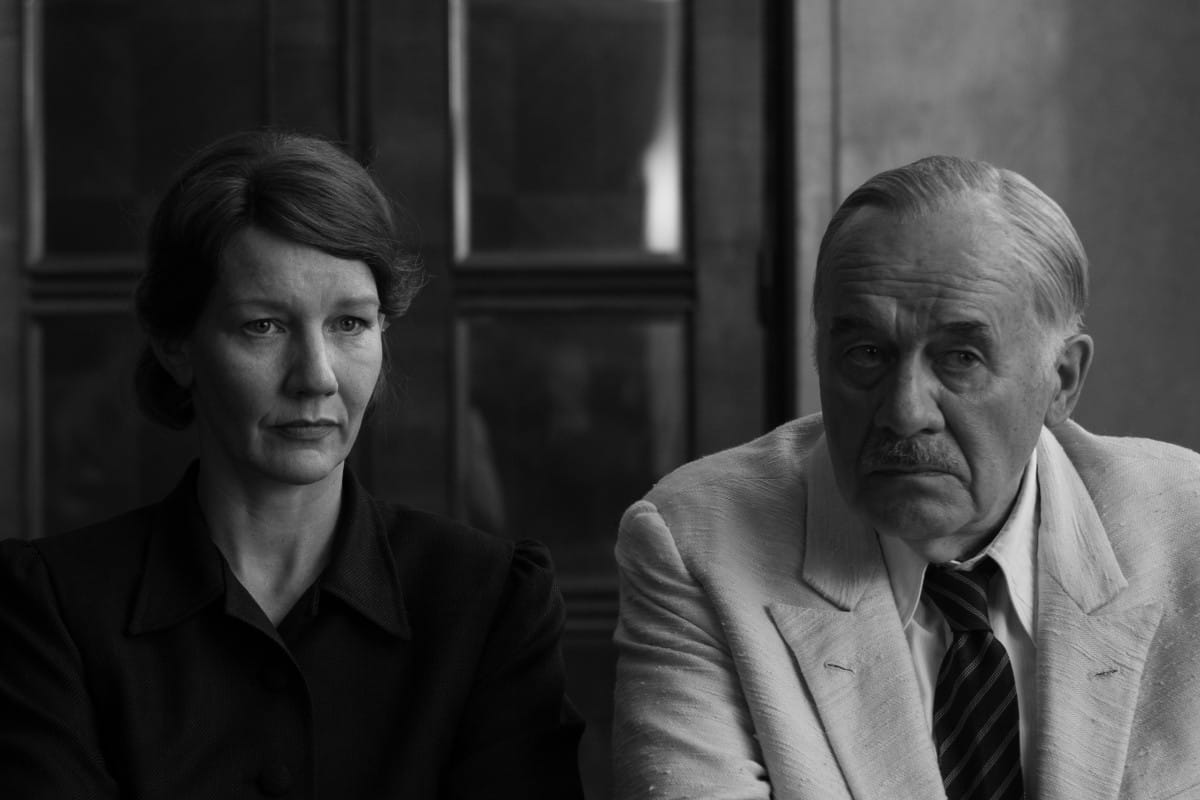
What kept me in my seat was the image. Fatherland is arguably one of the most beautifully shot films of the year, and I’m a sucker for black-and-white when it looks like this. Łukasz Żal (The Zone of Interest) frames shots almost like sculptures, with gorgeous texture across the whole boxy frame and immersive angles on a ruined country and its architecture. Production design deserves credit too. Every time the story slipped away from me, the visuals pulled me back — and that happened a lot.
The story covers a few days in 1949. Thomas Mann, Nobel laureate and anti-fascist exile, returns to Germany for the first time in sixteen years, with his daughter Erika behind the wheel, to be honored in both the American-run West and the Soviet-controlled East. Underneath that, Fatherland is about home and whether one still exists. Each half of a divided nation wants to claim Mann, his own family carries fractures that mirror the country’s, and Erika spends the trip protecting a father who rarely looks back at her. Pawlikowski never hammers any of this, and restraint is the keyword from start to finish. I like that. The contrast between Frankfurt’s glossy receptions and Weimar’s gray, empty squares is excellent visual storytelling. Even from a biopic standpoint, it’s refreshing to get a few days instead of a bloated march through someone’s entire life.
Where it lost me is the narrative and the characters, the two pillars of any movie. Pawlikowski himself has called Fatherland more intellectual than emotional, and I felt that distance the whole way through. Without any background on the Manns, Gründgens, or even Goethe, I struggled to understand where this road trip was headed or why. Instead of digging into the father-daughter dynamic, the film keeps replaying the same sequence in a new location: a dinner or gala, a speech that Erika herself dismisses as empty words, a choir singing, and off to the next city. A “nothing happens” movie doesn’t bother me per se. But when the characters are this self-contained and this cold, inside an equally austere atmosphere, it just doesn’t do enough to keep me hooked. The family’s sexuality, a major issue for the time, is barely touched, and other promising threads get dropped quickly. August Diehl (Inglourious Basterds) and the supporting cast do what they can with people the film barely lets us know.
Sandra Hüller (Anatomy of a Fall) is the main reason I’m mixed rather than negative. She’s essentially the only character allowed to show emotion, and she nails every moment, from her restraint in deeply complicated situations to a confrontation with her ex-husband and, later, with her father shortly after devastating news. Hanns Zischler (Munich) plays Thomas exactly as written, serious and stern and closed off, so in that sense he gets it right, even if real expressiveness only arrives in the final scene.
That ending is bittersweet, and it has every element in place to be the devastating finale so many people are praising, with the father-daughter dynamic culminating in an admittedly beautiful moment. Sadly, I felt nothing. Visuals, at their most astonishing, can carry a movie to safe harbor, but they can’t matter more than the story they’re serving. This is a demanding, rather inaccessible film meant for arthouse audiences more than the general public, and maybe they’ll be moved where I wasn’t. I just wish I’d cared about anyone inside those undeniably stunning frames.
Rating: C