‘Wildwood’ (2026): Laika Delivers a Stop-Motion Generational Masterpiece
Laika’s longest and most ambitious film is a handmade, deeply emotional fantasy epic, and an instant classic. A true masterpiece.

I'm cautious with A+ grades. I can go a long time without giving one, and I'm even more careful with often overused terms for engagement's sake like "masterpiece" or "classic" after a single viewing, simply because first impressions can fool you, sometimes even due to external factors. So, please, read everything that follows knowing how rarely I say any of it. Wildwood is a masterpiece! I know how that sounds coming from me, and I'm saying it anyway.
This was one of my most anticipated films of the year long before the festival buzz turned into full-blown hype. Laika is one of my favorite animation studios because nobody does stop-motion like them, and Travis Knight (Kubo and the Two Strings) gave me my favorite of theirs ten years ago. I walked in extremely excited, with dangerously high expectations, quietly hoping for a new personal favorite. I didn't know the premise. I didn't even know the runtime. But I did get the favorite I was hoping for.
What the synopsis doesn't tell you is how close to home all of this happens. Wildwood is set in Portland, Laika's own backyard, and its enchanted forest sits right at the edge of the city, a stretch of wilderness everyone knows to stay out of. Prue (Peyton Elizabeth Lee, Secret Society of Second-Born Royals) stopped believing in the bedtime stories her father reads a long time ago. Curtis (Jacob Tremblay, Room) is the dreamy, easily frightened classmate who ends up following her in. What they find inside is no quiet fairy-tale setting. The forest is full of talking animals, uniformed coyote soldiers, an avian court, outlaw bandits, and rival territories already on the brink of war. At the center of it all is Alexandra (Carey Mulligan, Promising Young Woman), the Dowager Governess who once ruled these woods.
Let me get the obvious praise out of the way, even if it's hard to make it sound like anything other than a generic compliment. There's no way to put into words the work everyone at Laika put into this, every single day, for years. It's arguably the studio's most ambitious movie, and it's easily their most impressive in scale and scope. Think about the sheer number of sets, puppets, printed faces, feathers, leaves, and countless other elements that would blow any viewer away. Then remember that all of it had to stay consistent across an endless number of tiny details. It's mind-blowing, and worthy of every award imaginable and then some. The end credits offer a small glimpse of how it was all made, which I loved. I kind of wanted more of it.
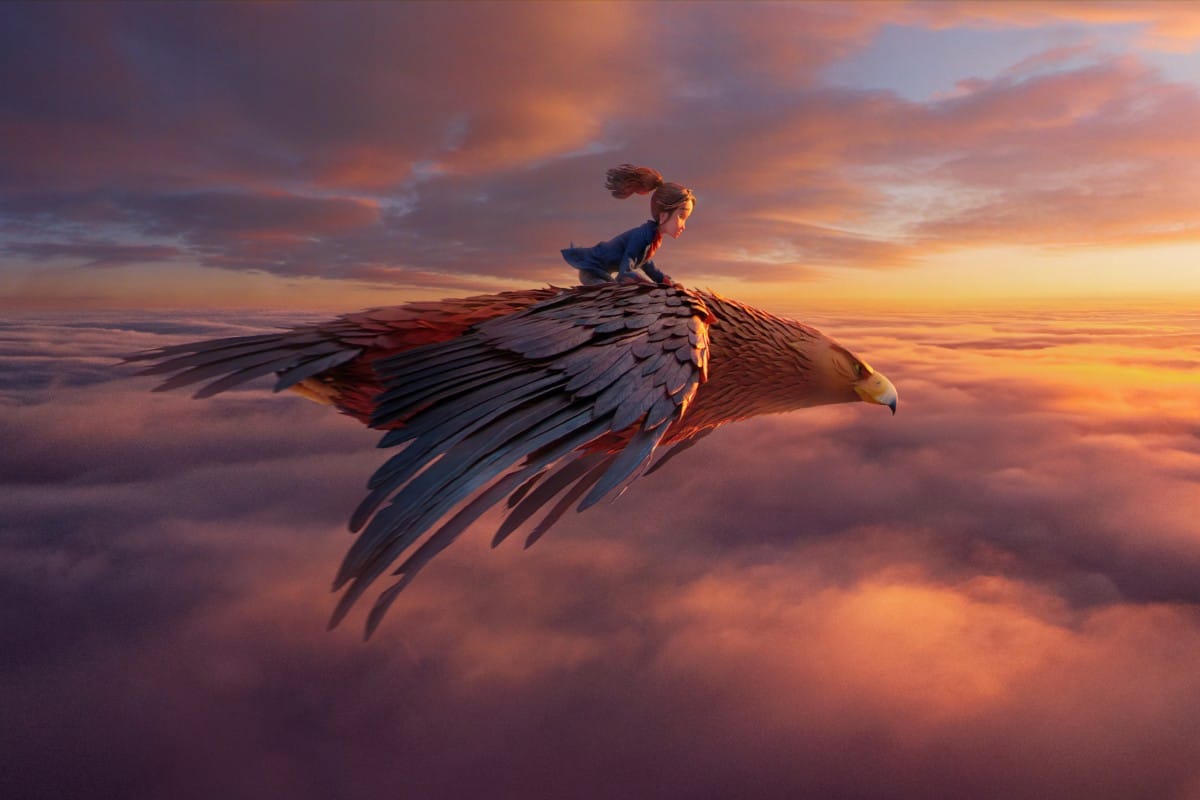
Some numbers help explain why I keep reaching for words like "impossible." Laika optioned the novel in 2011, just weeks after it was published, but production only began in 2021, and it then ran for 231 weeks — more than four years. Over 1,000 artists, craftspeople, and technicians worked on it, with just 49 animators bringing its 2,804 shots to life across 136 sets and more than 230 handcrafted puppets. Every main character gets bespoke facial animation for every shot. That adds up to over 140,000 3D-printed faces, breaking the world record Laika itself set with the 106,000 it used on Missing Link. The General (Angela Bassett, What's Love Got to Do with It), a giant golden eagle, wears thousands of feathers, each one dressed and attached by hand. One animator reportedly spent around four years on a sequence where Prue climbs onto the General's back, a scene that plays for only a few minutes on screen. The final battle alone runs close to 12 minutes and 411 shots, every one of them posed by hand, one frame at a time, 24 frames for every second you watch.
Guillermo del Toro (Pan's Labyrinth) likes to remind everyone that animation isn't a genre, it's a medium. Wildwood is the best argument for that I've seen in years. It deserves a Best Picture nomination, animated or not. Yet for all those staggering numbers, what struck me most is how quickly I stopped wondering how any given shot was pulled off. The editing is pristine, and the small amount of CG work blends in so well that I never caught a seam. I never got that "oh yeah, this is very much stop-motion" moment that pulls you out for a second. From the first minutes, I was absorbed in a world I fully believed in.
It's a heavy world to believe in, too. There's some light humor early on, mostly in the family dynamics and the banter at home, where Jake Johnson (Safety Not Guaranteed) and Maya Erskine (Wine Country) are lovely as Prue's parents. The darkness arrives fast, though. You could argue it's there from the very start: the opening scene is one of the most devastating I've ever seen in an animated film, and it tells you right away this won't be a Disney fairy tale. Wildwood is grim and gothic, much closer to Tolkien or Miyazaki than to anything Mickey Mouse's studio makes. It trusts its audience to sit with that darkness and find the bittersweet, vital messages underneath. The violence is taken seriously and never played for cheap entertainment.
Prue's arc is where the story does its quiet, essential work. She starts out as someone who doesn't believe in magic. More than that, she doesn't seem to believe in wonder at all, as if caring about any of it were something to grow out of. What I love is that Wildwood never makes her journey about being convinced. She doesn't walk into that forest because someone proves magic is real. She walks in because her brother is in there. She acts on love, and belief follows the action, not the other way around. Lee nails this role. Her Prue is superb and beautifully empathetic, and that empathy keeps reaching further the deeper she goes into the woods.
That idea of belief ties into something the movie keeps circling: rules, and the borders they create. Prue's parents have rules. Her city has a forest nobody enters. Inside it, there are more lines than anyone can keep track of, from territories, courts, and governments to outlaws, who belongs where, and who isn't allowed in at all. Every society in this film is defined by the boundaries it draws, and the story keeps asking who drew them and why. Some protect people. Plenty exist only out of fear. Prue's whole adventure begins with breaking the one rule she was always told to obey, and the movie never pretends that was the wrong call.
Some borders aren't on any map, though, and Alexandra is the clearest example. Mulligan has impressed me plenty of times before, but this is something else. She's menacing and sympathetic at once, and I genuinely wanted her to be saved, to get a happy ending, even as she became the biggest threat in the story. Alexandra once ruled these woods with kindness. Grief changed that, and Wildwood is careful about how much it reveals and when, so I'll leave it there. What matters is watching that grief slowly blur the line between right and wrong until she can't see it anymore. Almost everyone in the film is losing someone, afraid of losing someone, or trying to undo a loss. Alexandra is what happens when grief has nowhere left to go.
Curtis will be the favorite of many viewers. Tremblay nails the weird, scared little dork, the kind of kid who has read about adventures his entire life and never imagined actually living one. The forest hands him exactly the adventure he always dreamed about, and he learns fast that the real thing costs more than any storybook warned him. I won't say how he gets there, but by the end this jittery kid becomes the bravest, strongest character in the whole movie.
The world these two kids stumble into is phenomenal, and so vast. The forest, the waterfalls, the mountains, the creeping ivy, the little villages tucked between the trees — the visuals are out of this world. Then there's the variety of animals, costumes, and social roles, with every corner of the wilderness seeming to have its own customs and its own place in a larger order. It's almost incomprehensible that something this big was achieved this cleanly and clearly. Caleb Deschanel (The Right Stuff) deserves enormous credit, too. His cinematography is beyond purposeful and stunning, and like the film itself, it should be competing in the main categories at every awards show usually reserved for live-action.
All that world-building feeds into the war at the heart of the story, and Wildwood treats it as a question of power: who holds it, who lost it, and who is willing to fight for something better. Brendan (Mahershala Ali, Moonlight), the Bandit King, stands at a very different point on that question than the General or Owl Rex (Richard E. Grant, Can You Ever Forgive Me?), an aging owl with royal blood. Ali, Bassett, and Grant all play incredibly moving, brave characters. None of them gets the spotlight for long, and all three leave a mark anyway.
Then there's the final battle. I'm a massive The Lord of the Rings fan. It's my all-time favorite trilogy, it means the world to me personally, and I traveled to New Zealand on my honeymoon almost exclusively because of it. I can count on one hand, without needing every finger, how many movies or TV episodes have made me feel what the Battle of the Pelennor Fields in The Return of the King or Helm's Deep in The Two Towers made me feel. Wildwood joins that tiny group. Its climax is insanely complex, brutally violent, kinetic, energetic, and epic, with a fantastic emotional throughline running all the way through it. It genuinely defies what stop-motion, or animation, period, is supposed to be capable of. It's everything I'd want a climactic battle to be, and it will go down as one of the very best ever put on screen.
Dario Marianelli (Atonement) gave me chills multiple times. He made me cry multiple times, too. His score is sweeping, epic, and overwhelmingly emotional, and the sound design deserves equal praise. For a film I walked into with no idea how long it was, the pacing felt perfect. Wildwood ends exactly when it needs to, with no loose threads and no subplot, character, or theme left underdeveloped.
As I always say, story is king. All of this craft and all of these performances would mean much less if the story didn't connect, and this one connected completely. It's rich, heartfelt, and tragic. It's a story about grief, family, and sacrifice where the lore feels like part of the narrative instead of homework, and the stakes are high and consequential. It's a coming-of-age story that never tells kids to outgrow their wonder or their sense of awe, and I genuinely believe it will define childhoods. I have no notes. None. I know some will point to the exposition, the flashbacks, a familiar structure, a tone too dark for younger kids, or animation that's almost too polished. Maybe that's fair for them. Not for me. Saying it's a generational classic might sound like a lot after one viewing and against many of my well-set "rules" on cinema, but just like Wildwood taught me, I'm comfortable with breaking it.
It also matters, at least to me, when this movie exists. We're living through an age where AI is taking over everything, and its growing role in cinema feels sadly unavoidable. Watching Wildwood felt refreshing, authentic, almost altruistic. Laika, with Knight as both director and CEO, keeps making these extraordinarily difficult films even though they rarely turn much of a profit, if they turn one at all.
The theme that means the most to me, though, is a very Tolkien one. In The Hobbit: An Unexpected Journey, Gandalf says it's "the small everyday deeds of ordinary folk that keep the darkness at bay." In The Two Towers, Sam, a gardener who never asked to be part of any of it, reminds Frodo that "there's some good in this world, Mr. Frodo, and it's worth fighting for." Both lines are dear to me, and Wildwood runs on the same belief. In a world of eagles, armies, and royalty, the ones who matter most are often the runts, the rats, the creatures nobody bothers to count. Septima (Awkwafina, The Farewell) is one of them. I've been critical of Awkwafina's live-action performances in the past, and I had some notes on her voice work in Raya and the Last Dragon, too. Here she plays this little rat so convincingly and so warmly that she made me cry. It's not only Septima, either. It's Prue, an ordinary teenager with no destiny, and Curtis, the scared kid nobody would pick for a hero. Nobody chose them for anything, and they show up anyway.
Final Thoughts
Wildwood is a true masterpiece, and I don't use that word lightly. Travis Knight and everyone at Laika spent years building, by hand, the most impressive stop-motion movie I've ever seen, one that deserves the "generational classic" stamp. Caleb Deschanel's cinematography and Dario Marianelli's score belong in every major awards conversation, as the final battle sits right next to the greatest set pieces ever put to screen. Peyton Elizabeth Lee and Jacob Tremblay carry two beautiful arcs. Carey Mulligan makes sorrow terrifying and heartbreaking at the same time. It's a dark, brave, deeply emotional story about grief, family, sacrifice, and, in a very Tolkien manner, the courage of small creatures and their everyday deeds to keep darkness at bay. No notes. I'll forever cherish this treasure.
Rating: A+