'Enola Holmes 3' (2026): Growing Up Without Losing Your Voice
Balancing a sluggish narrative puzzle with artistic whimsy and a resonant look at the constraints of institutional marriage.

Returning to this now-trilogy brought a specific set of expectations, particularly after the near-perfect balance achieved by the previous installment. While the second film remains my personal favorite, Enola Holmes 3 lands exactly where the first one did, offering a thoroughly enjoyable yet uneven ride. There's a comforting familiarity in diving back into a stylized version of Victorian London - now appearing only in a few flashbacks, giving up the location spotlight to Malta - but it's impossible not to notice how the narrative gears grind a bit harder this time around. The franchise - can I call it that? - still carries its distinct personality, but the seamless flow of past adventures feels slightly bogged down by its own ambition.
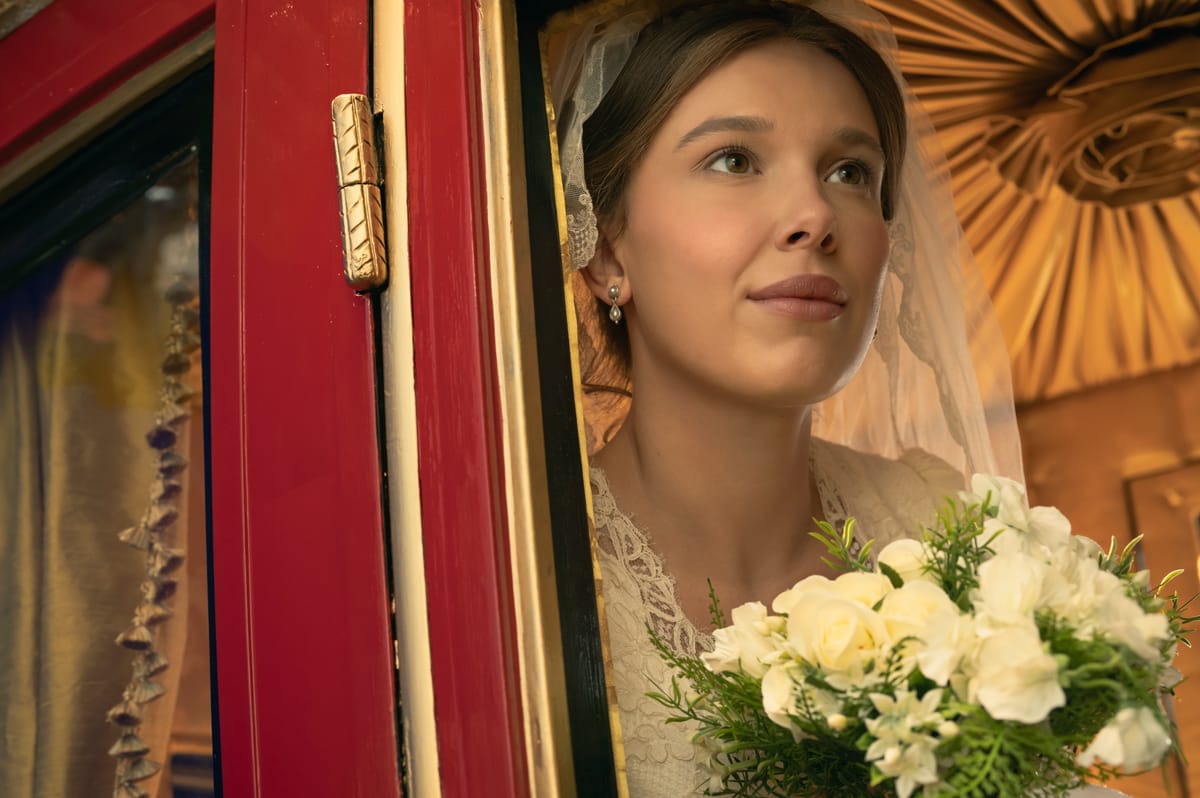
At the absolute center of why these movies work so well is Millie Bobby Brown (Stranger Things). It might sound like a hot take given her iconic breakthrough role as Eleven in the television series, but I genuinely believe Enola represents the finest work of her career so far. She possesses a rare, fluid diction that makes the rapid-fire, witty monologues feel completely effortless, anchored by an expressiveness that commands the screen. Henry Cavill (The Witcher) similarly delivers far more than expected, bringing a grounded, layered warmth to this version of Sherlock that plays beautifully against Enola. It's a wonderfully cast ensemble, and watching Enola grapple with her fears of marriage, the institutional loss of her independence, and the weight of taking on a new name provides a genuinely compelling emotional core.
Unfortunately, Enola Holmes 3 stumbles by heavily overstuffing its canvas. Where the predecessor efficiently tied real-world history into its narrative, director Philip Barantini (Boiling Point) struggles to juggle the disjointed political movements of Malta alongside sudden subplots involving Afghanistan. There was more than enough dramatic meat in Enola's personal identity crisis to sustain the film, making the geopolitical scale feel cluttered rather than impactful. This narrative bloat directly hurts the mystery, which stands as the least convincing of the trilogy. Because Moriarty was established as the looming threat from the start, the audience remains a full step ahead of Enola for the entire first half, making it frustrating to watch incredibly brilliant detectives take an hour to deduce what regular viewers figured out even before the start of the movie.
Where Enola Holmes 3 redeems itself is in its gorgeous, unwavering commitment to style and visual identity. I absolutely adore the little creative cues sprinkled throughout, from a crucial piece of clothing subtly highlighted on screen, to hand-drawn maps actively scribbling themselves out, and letters floating out of notebooks to align in mid-air. These imaginative details represent my favorite technical element of the entire trilogy, and when paired with stunning practical locations and exquisite costume design, they completely rescue the film from that bland, uniform aesthetic that plagues so many streaming blockbusters.
Even when the plotting loses its footing, the trilogy holds fast to an artistic soul that delivers a sweet message about how growing up never means losing our unique sense of wonder.