'The Odyssey' (2026): Christopher Nolan's Most Faithful Epic Is Also His Most Ambitious One
A ten-year journey home that refuses to skip a single step of Homer's poem, and somehow still finds room to breathe.

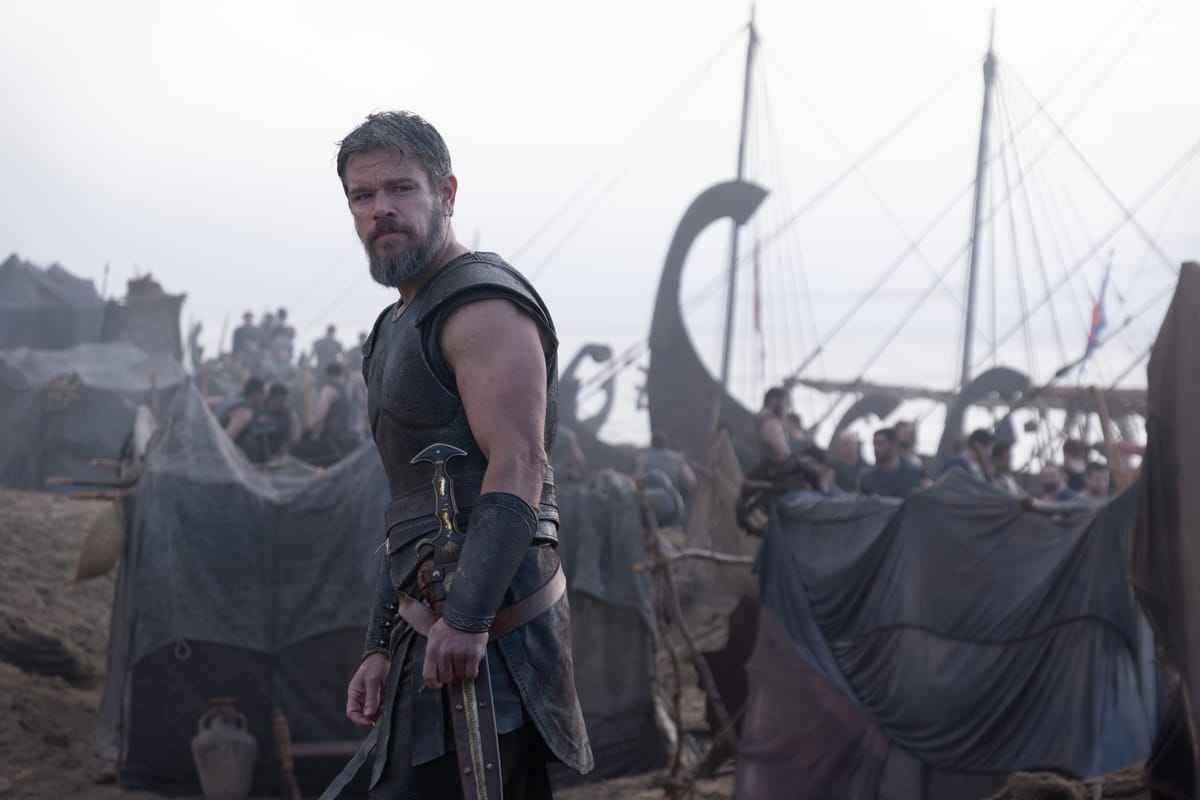
I want to get one thing out of the way before I say anything else about The Odyssey: I'm not going to tell you where it ranks among Christopher Nolan's (Oppenheimer) filmography, and I'd encourage you to be suspicious of anyone who rushes to do so within hours of walking out of the theater. That instinct to immediately slot a new release into a hierarchy, as if the ranking itself were the review, tells you nothing about whether the person actually connected with what they just watched. What I can tell you is that this is a brilliant film, one I expect to be talking about at the end of the year, and that's a far more useful insight to know than where it lands on some invisible scoreboard. I was lucky enough to catch it in a non-IMAX 70mm showing — my first time experiencing the format — and the jump in clarity and texture was startling, like switching from a decent stream to true 4K. I'm already plotting how to get myself into an IMAX 70mm screening before this leaves theaters, because I suspect I've only seen a fraction of what this movie is capable of showing me.
What struck me most is how Nolan manages to make faithfulness itself feel like an act of ambition. This isn't a loose, reinterpreted take on Homer's poem; it's remarkably comprehensive, carrying over beats and episodes I assumed would get trimmed for time. That it does all this in under three hours is honestly baffling, and it results in filmmaking that's maximalist by design, throwing war, myth, horror, and domestic drama at the viewers almost simultaneously. Yet, the ending doesn't buckle under that weight. It contracts instead, landing somewhere quiet and contemplative after everything that came before it, which is its own kind of directorial control. Scale-wise, I'll admit something like the recent Dune films might out-muscle it in raw size, but scale was never really the point here. It's the scope, the sense that an entire ten-year odyssey has been compressed without being hollowed out, that left me stunned.
The ensemble is one of the largest Nolan has ever assembled, and it delivers across the board. Matt Damon (The Martian) gives what might be the best performance of his career, carrying Odysseus's exhaustion and guilt in ways that never tip into melodrama. Tom Holland (Spider-Man: No Way Home) continues to prove he's more than capable of handling material this heavy, and Samantha Morton (Minority Report) makes an outsized impression in what amounts to a single extended sequence, one of the movie's most haunting stretches. John Leguizamo (Moulin Rouge!), Robert Pattinson (The Batman), and Anne Hathaway (The Devil Wears Prada) all get moments to shine as well. I was a little surprised by how limited the screen time is for actors like Mia Goth (Pearl) and Lupita Nyong'o (12 Years a Slave), given the marketing weight put behind them, though I'd rather see a small role well-acted than a big one wasted. And I'll say this plainly: the backlash aimed at Nyong'o's casting as Helen of Troy, a character never explicitly described as white in the source material, targets one of the most minor figures in the entire story. It's a manufactured controversy that says far more about the people upset than it does about the film.
Craft-wise, this might be Nolan at his most technically alive. The camera work is unusually inventive even by his standards, the practical effects work is deceptively convincing (there were moments I genuinely couldn't tell what was built and what was digital), and shooting on real locations gives everything a lived-in, tactile weight. There's also a horror current running through several of the movie's biggest set pieces that I wasn't expecting, and now I'm quietly hoping it's a sign Nolan has an actual horror flick in him somewhere down the line. Combine that with some of the most bruising war and action sequences of his career, and you get a blockbuster that's constantly shifting registers without ever losing its footing. Ludwig Göransson's (Black Panther) score is exceptionally powerful. It's bass-heavy to the point that my seat was physically vibrating, and it's also some of his most emotionally direct work, chill-inducing in the quieter passages and thunderous in the bigger ones. Every filmmaking department here is pulling its weight.
What ties it all together is that underneath the mythology and the spectacle, this is fundamentally a character study, one where the gods aren't decorative but woven so tightly into the fabric of the story that the whole thing paradoxically feels more grounded, not less. Yes, it's a heavy watch, and yes, the first half leans expository in a way that demands patience. But I'd push back on calling it overstuffed. This is the foundational epic of Western literature we're talking about; a version of it that felt breezy or streamlined would have betrayed the material. The density is the point. The chaos is part of the journey, exactly as it should be. Some movies you finish and immediately want to rewatch just to catch what you missed the first time around, and The Odyssey is one of those rare epics that rewards you for making the trip alongside it.
Update — Second Viewing
I went back to The Odyssey a few weeks after its premiere, already anticipating being hit even harder than the first time, now that I knew how Nolan adapted Homer's poem from top to bottom and could see exactly where certain scenes were headed. I'd spent these weeks unable to shake a handful of moments that had already brought me to the brink of tears back in the first viewing, so I walked in highly anticipating them, but even that kind of anticipation didn't prepare me: I came out having cried through a lot of it. The scene where Odysseus finally tells Penelope what the Battle of Troy actually cost him, with Athena (Zendaya, Euphoria) listening in silence next to them, is the closest this film gets to pure, unadorned cinema. What lands so hard on a second watch is how completely the movie reframes the war through Odysseus's eyes alone: not the sanctioned version Ithaca has been telling itself for a decade, but his own reckoning with how thoroughly it hollowed him out, how it was Odysseus and his men, not the Trojans, who broke Zeus's law of hospitality and became, in the film's own haunting phrase, the sea people. The way that battle is staged as memory rather than spectacle, Ludwig Göransson's score turning genuinely mournful underneath it, and the single, brutal image of Athena carrying out a beheading mid-recollection, all of it together is filmmaking and storytelling operating at their absolute peak, and I don't say that lightly. Honestly, I genuinely believe it's one of the best scenes I've ever witnessed on the big screen.
The rest of The Odyssey benefits from the same clarity. Knowing where every thread leads the first time around, I found the movie moves with a confidence and ease I underrated back in July, and I genuinely can't point to a single scene I'd cut, which isn't something anyone says often about a nearly three-hour blockbuster. All of that pushed me somewhere I don't reach for casually: this is my first A+ since Dune: Part Two, and it's earned every bit of it. Some films tell you everything you need to know in one sitting; but some of the great ones, it turns out, only finish revealing themselves completely after you let them in multiple times.
Rating: A+