'Pressure' (2026): A Terrific Ensemble Elevates a Story That Never Quite Earns Its Runtime
Andrew Scott carries Anthony Maras' handsomely crafted D-Day drama past a repetitive script that forgets the one meteorologist who actually deserved the spotlight.


The first thing that struck me about Pressure wasn't anything happening inside Southwick House — it was the score, announcing itself within minutes with a familiarity I couldn't place until I did: Volker Bertelmann, running the same anxious, propulsive engine that powered Conclave and, more recently, Ballad of a Small Player. I confess that recognition set the tone for the whole watch: admiring craftsmanship, thoroughly won over by a strong cast, never quite pulled all the way into the story. A well-made film that never exceeds the sum of its parts.
Structurally, Pressure commits fully to its premise, unfolding entirely across the 72 hours before D-Day as Captain James Stagg and Colonel Irving P. Krick (Chris Messina, Sharp Objects) argue over conflicting forecasts while General Dwight D. Eisenhower decides whose numbers to trust with the invasion's fate. It's a clever inversion of the war movie — beachheads swapped for barometers, spectacle for procedure — and it does land its point: that Overlord hinged as much on meteorological literacy as tactical instinct. The trouble is that watching people chart isobars and cycle through variations of the same argument for the better part of ninety minutes is, on paper, exactly as dry as it sounds, especially once you remember walking in that everyone already knows how June 6th turned out.
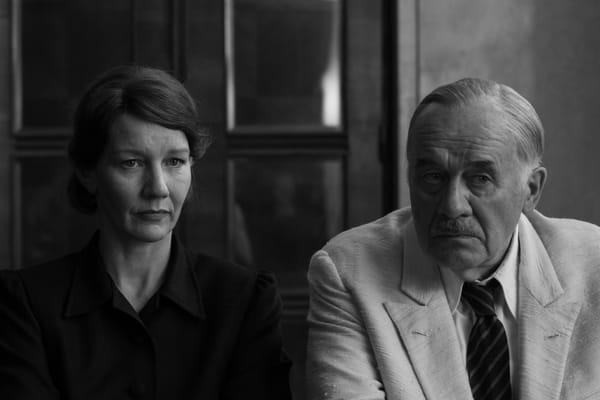
Where Pressure earns its keep is almost entirely in the ensemble. Andrew Scott keeps building an overwhelming case for A-list status the industry still hasn't quite handed him — his Stagg is coiled and exacting, carrying most of the film's tension through posture and clipped diction alone. Messina, cast as the ostensible antagonist, matches him beat for beat and remains criminally underrated for it, letting Krick curdle from overconfident to wounded by the end. Kerry Condon (The Banshees of Inisherin) does what she reliably does in support: outshine actors given twice her screen time, bringing real warmth to a movie that otherwise runs cold. Brendan Fraser (The Whale), by contrast, has absorbed most of the discourse around this film, and I don't fully share it — I have no fixed image of the real Eisenhower, and suspect some of that criticism is more culturally specific than it admits. Where I'll meet it halfway is on characterization: Fraser often feels cast to deliver forceful, awards-reel-ready lines rather than inhabit a full person.
Technically, Pressure is confidently assembled. Bertelmann's score does much of the emotional heavy lifting for scenes that are, by design, mostly men pointing at maps and phoning in numbers. Jamie D. Ramsay's (Living) cinematography settles into a muted, near-sepia palette that suits the procedural mood without turning precious, and director Anthony Maras (Hotel Mumbai) stages one genuine surprise: an actual glimpse of the Normandy landing, which I hadn't expected from a movie so committed to war rooms and radio transmissions.
What nags at me, though, has nothing to do with craft and everything to do with a choice made at the script level: Pressure builds its entire moral case around meteorologists being unsung heroes of D-Day, then leaves out the man most responsible for finding the storm gap and disputing Krick's data — Sverre Petterssen doesn't get so much as a mention. I understand the mechanics of streamlining a two-hander play into drama. But a film this insistent on correcting the historical record owes a passing nod to the person its own thesis is arguably about. It's a major omission that leaves a real aftertaste on an otherwise handsome, well-acted flick. In the end, a movie built around the idea that history overlooks its quietest experts forgets to extend that same courtesy to one of its own.
Rating: B-