‘Possible Love’ (2026): Lee Chang-dong’s Patient Class Drama Is Easier to Admire Than to Love
Lee Chang-dong’s patient study of class, marriage, and the power of a camera is anchored by four exceptional performances, even if its middle stretch asks a lot.

November is pull-quote season. Trailers and posters all seem to arrive with somebody declaring the movie in question the "film of the year", and after a while the phrase stops meaning much of anything. I try hard not to fall into the (over)hype trap at this point of the awards calendar because it can spoil a perfectly good movie before the lights even go down.
Possible Love came with more of that noise than most. It’s also my first film from Lee Chang-dong (Burning), so I had a huge reputation in front of me and no personal history to measure it against. What I did have was a real love for South Korean cinema. I just tried to keep my expectations somewhere moderate.
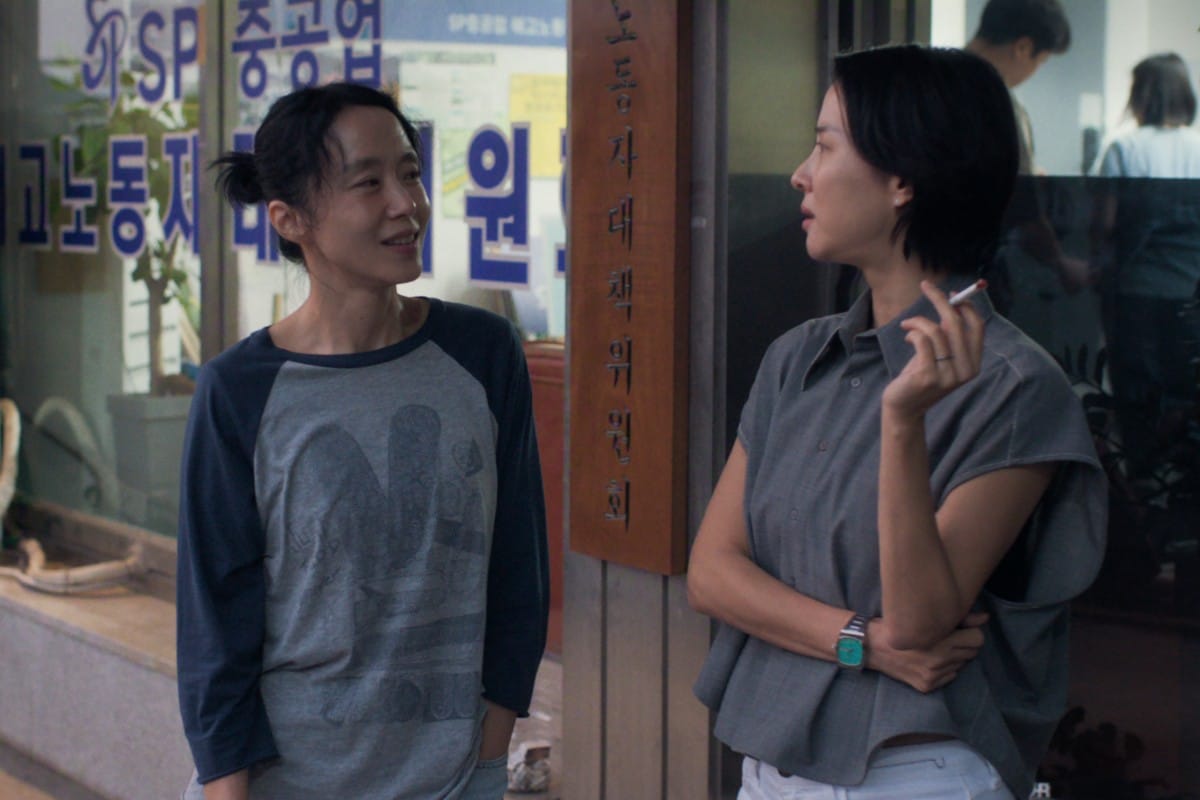
The movie opens with the Tenth Commandment, “Thou shalt not covet,” and then never preaches about it. Nobody gets punished for wanting, and nobody gets a sermon. Lee and co-writer Oh Jung-mi (Burning) simply give us four people who each want something from somebody else. Mi-ok (Jeon Do-yeon, Secret Sunshine) works at a mask factory and keeps her family afloat, while her husband, Ho-seok (Sul Kyung-gu, Peppermint Candy), has been drinking his way through the two years since a strike at his old plant ended in violence and mass layoffs. At a funeral, they meet Ye-ji (Cho Yeo-jeong, Parasite), a filmmaker making a documentary about those fired workers, and her wealthy husband, Sang-woo (Zo In-sung, Escape from Mogadishu). Mi-ok wants a little of the ease she sees in Ye-ji’s life. Ye-ji wants a story. Ho-seok just wants back the life he had before.
What hit me first was how lived-in the whole thing feels. The conversations sound like real people talking over one drink too many, and the details are specific enough that it rarely feels written at all. A lot of films about class lay their commentary on top of the characters, or run it in a separate lane beside them. Here, it runs straight through them. Everything I learned about money and privilege came from the same place I learned about these four people: how they treat each other, the stories they tell, and the life experiences that slowly come out over dinners and drinks. Mi-ok quietly looking up what Ye-ji’s handbag costs, or gently suggesting her new friend wear something cheaper before interviewing people who lost their jobs, says more about the gap between them than any speech could.
Ye-ji is the character I enjoyed trying to figure out the most, mostly because I never could. Is she making this documentary because the material is good, or because she genuinely feels for these people? Possible Love never really settles it, and Cho plays her with enough sincere warmth that the question stays open. The signs keep piling up, though. Someone shares a deeply personal, sometimes devastating memory, and instead of reaching out or looking shaken, Ye-ji lights up with a barely hidden “this is going to look great” excitement. Someone starts talking, and she stops them so she can go turn the camera on. When the conversation finally turns to her own past, she switches it off first. It’s a tiny gesture, easy to miss.
That camera is the most powerful object in Possible Love. Whoever holds it decides when a life becomes material, which parts get recorded and which get to stay private, and only one person in this story gets to make that call about herself. For Mi-ok and Ho-seok, their pain becomes the one thing they have that the rich couple wants, and confession slowly turns into a kind of currency. Lee doesn’t spell out how uncomfortable that exchange is, but instead makes us sit through it, interview after interview.
Everyone seems to be talking about You Can See Everything as this year’s big documentary/fiction hybrid, which I find a little funny because Possible Love might be the hybrid that deserves more of that attention. Talking-head interviews, Ye-ji’s footage, and the movie's own camera keep overlapping. I love how the flashbacks slide in while characters narrate their own stories, past and present blending without a hard cut announcing the switch. The same approach also makes the film blunt at times. So much of the story is delivered through people explaining what happened to them that it gets heavy on exposition, and now and then the script spells out something the actors had already made perfectly clear with a look.
Those actors are the standout here. All four leads are exceptional, and I wouldn’t be surprised to see a few of them pop up during awards season, Do-yeon above all. Mi-ok is the warmest presence in Possible Love, chatty and hopeful and a little starstruck by Ye-ji’s world, but Do-yeon lets you see how much effort that brightness costs her, especially in the moments when she’s simply listening to someone else. Kyung-gu has the opposite job, playing a man so shut down that for long stretches he gives almost nothing away, which makes the moments when Ho-seok finally cracks hit that much harder, while In-sung turns Sang-woo’s easy charm into something that feels generous and slightly hollow at the same time.
Both couples have spent years together, and the movie doubles as a portrait of two marriages drifting apart for completely different reasons. Mi-ok and Ho-seok clearly still love each other — the flashbacks to their younger days make that obvious — but money and his silence keep putting more space between them. Ye-ji and Sang-woo look like equals from the outside, yet their distance seems to come from the opposite place: a comfort so complete that neither of them ever really has to need the other. I just wish the wealthy marriage got the same attention. The working couple’s relationship is fully drawn, with a shared history and all the tenderness and resentment that come with it, while Ye-ji and Sang-woo remain sketchier than they should be. The hint of attraction crossing over between the two couples never convinced me, either. I understood why the story wanted that tension, I just didn’t buy it.
That’s also where the title starts to sting. Possible Love keeps testing which kinds of love can survive a class gap: a friendship between two women from different worlds, two marriages under very different kinds of pressure, and the solidarity that once tied Ho-seok to his fellow workers before the strike broke it apart. The fired workers call themselves “the dead” and the ones who kept their jobs “the living,” and that one detail says plenty about what happened to the brotherhood between them. Money is in the room every single time. Lee never claims love is impossible... he just shows how many conditions get attached to it once wealth enters the picture.
As a slow burn, it mostly rewards the patience it asks for, carefully building toward what it eventually pays off. The second act is the heaviest stretch, though. That’s where the 164 minutes feel the longest, and where the film gets a bit redundant. A scene makes its point, the actors give it everything it needs, and then it keeps going for another minute or two while the camera rolls on.
Technically, Possible Love is a restrained work, and I’m all for that when a story has this much going on in its characters and ideas. I had the opposite problem with Primetime, where the visual flair kept getting in the way until it became a distraction. Here, the cinematography by Kim Ji-yong (Decision to Leave), the editing by Kim Da-won (Burning), and the score from Jung Jae-il (Parasite) all exist to complement the story. None of them tries to take it over, or even to lift it into something showier. There are a few humorous moments sprinkled in, too, though they’re so sparse that I’m still not sure how well they fit the overall tone.
The final act is where all that building pays off. Some of the movie's most powerful moments are monologues, characters finally saying out loud what happened to them, and after so much silence, they carry real meaning. Then comes an ending that refuses the predictable path. It ignores the usual conventions and even the outcomes the film itself seemed to be hinting at, a bit like a balloon that keeps taking in air but never pops. I admire that refusal. It also means the ending is less climactic than everything before it seemed to promise, with none of the fireworks the build-up suggests. In the end, I understand why Lee went that way, given how quietly everything else in these characters’ lives falls apart.
Final Thoughts
I admire Possible Love more than I love it, but I really enjoyed it. Jeon Do-yeon leads an exceptional ensemble alongside Sul Kyung-gu, Zo In-sung, and Cho Yeo-jeong. Lee Chang-dong and Oh Jung-mi’s lived-in writing lets the themes run through the characters instead of over them. Ye-ji’s uncertain motives, the camera as a tool of power, and the portrait of two marriages drifting apart give it plenty to chew on. Meanwhile, the restrained work of Kim Ji-yong, Kim Da-won, and Jung Jae-il never gets in the way. The second act drags and repeats itself, the script leans on exposition, and the wealthy couple feels thinner than the working one. The cross-couple attraction didn’t convince me, and the sparse humor never quite settles in. The ending trades fireworks for something quieter, and I get the choice. Nearly three hours is a lot to ask, and most of that time is well spent.
Rating: B+