'Colony' (2026): Yeon Sang-ho Finds a Genuinely Smart Idea Inside a Familiar Zombie Formula
A tense, committed survival thriller whose thesis on empathy and communication earns your attention even when the rest of it plays it safe.

By the time I sat down for Colony, I'd already logged the full range of what Yeon Sang-ho can do: the genre-defining high of Train to Busan itself, the near-total misfire of Peninsula, and the solid, unspectacular middle ground of JUNG_E. I walked in with no fixed expectation, just genuine curiosity about which version of the director would show up this time. The answer, fittingly, is a bit of both extremes at once: an entertaining, tense genre exercise that's smart in exactly one specific way, and comfortably familiar in almost every other.
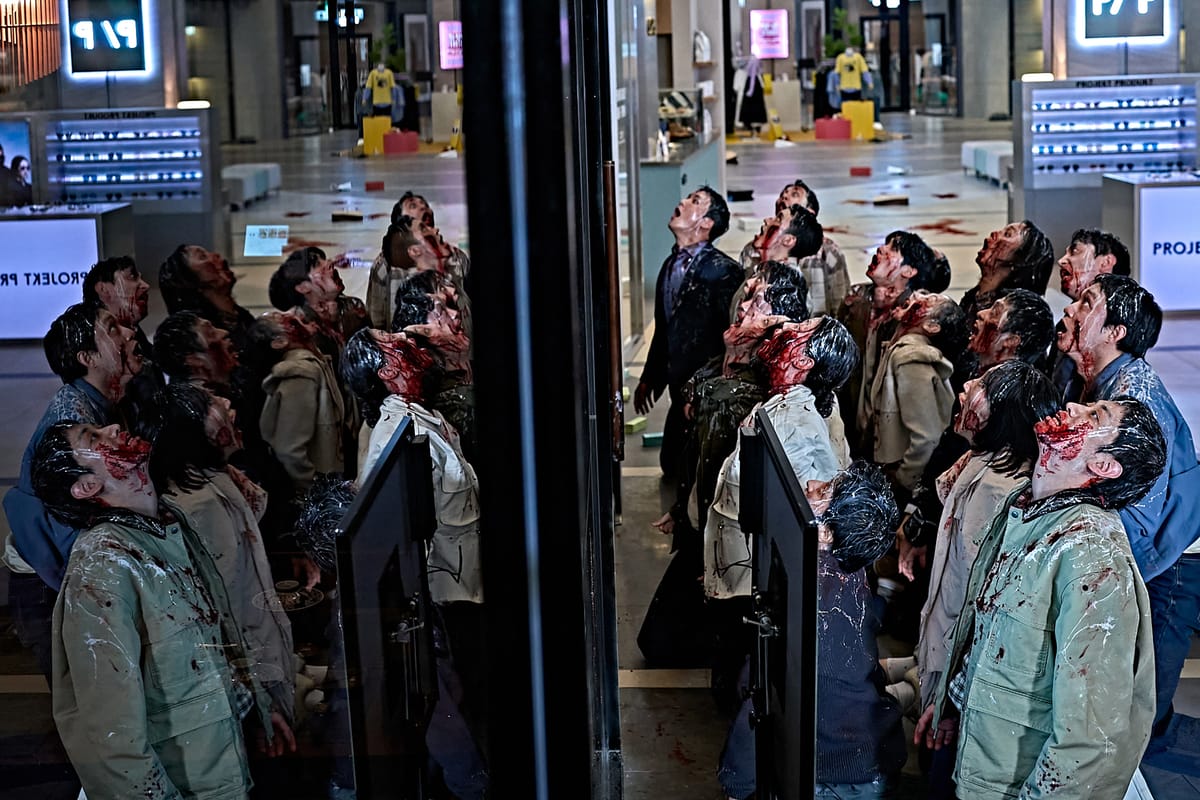
Colony returns Yeon to the confined-space formula that made the greatest zombie apocalypse film ever made work so well, trading a bullet train for a sealed-off Seoul skyscraper, and the claustrophobia still does real work. But the movie's smartest swing is conceptual: this outbreak doesn't just spread like the others, as the infected communicate, evolve, and coordinate because they've learned to understand each other in ways the human survivors never quite manage among themselves. That's the thesis running under everything — tragedy as a failure of empathy and honest communication, dressed up as body horror — and it crystallizes best in the bond between Kwon Se-jeong (Jun Ji-hyun, My Sassy Girl) and the scientist she's up against, whose entire descent traces back to not being heard. It's a genuinely sharp idea, and it's the reason Colony lingers after the credits roll.
The cast sells that idea even when the writing settles for archetypes. Jun Ji-hyun anchors the film with grounded authority, making it easy to believe a disgraced professor could hold a building of strangers together, while Koo Kyo-hwan (D.P.) makes for a coldly compelling antagonist rather than a simple monster. Ji Chang-wook (The Worst of Evil) and Kim Shin-rok (Hellbound) give real weight to their protective sibling dynamic, and Shin Hyun-been (Hospital Playlist) and Go Soo (Obsessed) round out the ensemble with solid, if thinner, material. The gore, creature design, and stunt work are all well-executed — full credit to performers throwing themselves into genuinely committed, contorting physical work — but none of it reaches for anything Korean genre cinema, or Yeon himself, hasn't already shown us.
The plot mechanics undo a lot of that goodwill, though. Several beats hinge on characters being slow to catch on to something about the antagonist that's obvious to the audience well before they do, and one specific device gets stretched past reason: they keep covering his eyes so he can't see, without ever covering his ears, and they keep doing it even after they've already learned he can hear everything. I rarely let movie-logic gaps bother me this much, but this one repeats so often, so avoidably, that it started pulling me out of characters I otherwise wanted to root for.
Even with that frustration, Colony stays a genuinely fun, tense couple of hours — a film that knows exactly what kind of ride it wants to give you and mostly delivers it, even without pushing past the shape of Yeon's earlier work. That said, I'll surely hold on to the movie's quiet suggestion that what can truly destroy us isn't zombies or monsters, but two people standing close enough to hear each other and choosing not to listen.
Rating: B